

Your ability.
Our support.
Your future.
Financial support for students with disabilities. The bursary opens doors to higher education and funds the additional teaching and support that remove barriers to teaching and learning.
Who can apply
You need to meet all three.
How to apply
Apply for 2027 funding in four steps.
Applying is free. Applications close on 31 October 2026. Prefer sign language? Watch these steps in SASL.
-
Create your myNSFAS account
You will need:
- South African ID number
- Cellphone number
- Email address
Already have an account? Log in and continue with your application.
-
Complete your application
Fill in your personal and household information, with accurate details of your household income. Then complete and submit the NSFAS Consent Form, which lets NSFAS verify the information you provide.
Students with disabilities must also submit the NSFAS Disability Annexure. Read about the Disability Annexure -
Upload your documents
Upload all the supporting documents required for your application, including a medical report where required. You can use your cellphone to take a photograph of each document.
-
Check and submit
Check that all your information is correct and every required document is uploaded, then submit your application.
Save your reference number after you submit.Track your status on your myNSFAS account.
Documents
What to upload, and how to make sure NSFAS can read it.
Upload all the supporting documents required for your application. You can photograph them with your cellphone.

What to upload
- Supporting documents required for your application
- NSFAS Consent Form, completed and signedDownload the form
- NSFAS Disability Annexure, completed, stamped and signedFor students with disabilities. Download the form
- Medical report, where requiredWhen a report is required
Before you upload, check that
- All four corners of the document are visible
- The document is clear and not blurry
- The text can be read
- No important information is cut off
- All required pages are uploaded
If a document cannot be read clearly, NSFAS may ask you to upload it again.
Download forms
Supporting documents for your 2027 application.
Download the forms that apply to you, complete them by hand, then upload them with your application.
Disability Annexure
Completed by a certified, registered medical practitioner or other appropriately qualified professional, such as an optometrist, physiotherapist or disability unit head. You do not need it if you already receive funding for students with disabilities.
Download PDF: Disability AnnexureConsent Form
Signed by you and by your parent, legal guardian or spouse. It allows NSFAS to verify the information you provide. Electronic signatures are not accepted.
Download PDF: Consent FormDeclaration Form
Completed by you and your parent, legal guardian or spouse, then confirmed by a social worker or the principal of the school you last attended.
Download PDF: Declaration FormOrphan or Vulnerable Child Form
Only for applicants under 18 who are orphans or vulnerable children. Completed by a social worker at the Department of Social Development.
Download PDF: Orphan or Vulnerable Child FormHow to complete the forms
- Write in CAPITAL LETTERS
- Use black ink only
- Write clearly, in full
- Do not use correction fluid
- All parties must initial any correction
- Sign by hand on the Consent Form
Disability Annexure
Students with disabilities must submit the NSFAS Disability Annexure with their application. It must be completed, stamped and signed by the appropriate qualified professional. Make sure it is complete, clear and easy to read.
Who completes it
A certified, registered medical practitioner or another appropriately qualified professional, such as an optometrist, physiotherapist or disability unit head.
You do not need the annexure if you already receive funding for students with disabilities.
Additional medical or professional report
Some students may need to provide an additional medical or professional report with their Disability Annexure. You may need a report if you have:
- A psychosocial or neurodevelopmental disability; or
- A chronic illness that affects your participation in teaching and learning.
The report must be from the appropriate qualified professional. A report for a psychosocial or neurodevelopmental disability must not be older than 3 years.
Support available
What the Disability Bursary Programme can fund.
Funding that removes barriers to teaching and learning, so you can take part fully in your studies.

Funding for assistive devices follows the same approval process as your financial aid.
Assistive devices
Eligible students may receive funding for assistive devices that support their participation in teaching and learning. Support is subject to approval and the applicable NSFAS processes.
Tuition
Your registration and study fees.
Human support
Some students with disabilities may need additional teaching or personal support to participate in their studies. This support is subject to eligibility, approval and the applicable NSFAS processes.
Accommodation
A place to live while you study.
Meals
Support for food while you study.
Transport
Getting to and from campus.
Submitting disability-related claims
How an assistive device claim reaches NSFAS.
The Disability Unit or Financial Aid Office at your college may submit assistive device claims to NSFAS, together with the three documents listed here. Ask them to submit yours.
Medical report
A medical report clearly indicating the need for the assistive device being claimed.
Quotation
A quotation for the assistive device.
Remember: applying is free.
Applications close on 31 October 2026. Apply early and make sure your application and supporting documents are complete.
Start your applicationAccessibility
This page is built so that everyone can find and use funding information.
- Full keyboard navigation
- Screen reader landmarks and labels
- Visible focus on every control
- High contrast mode
- Layout adapts when you zoom in
- SASL video with sound, captions and a transcript
- Plain language, short sentences
- Reduced motion respected
Students with disabilities apply with the same form. If you need help completing it, contact NSFAS or your institution’s student disability unit.
Get accessibility supportDisplay
Switch to black, white and gold with stronger outlines.
SASL support
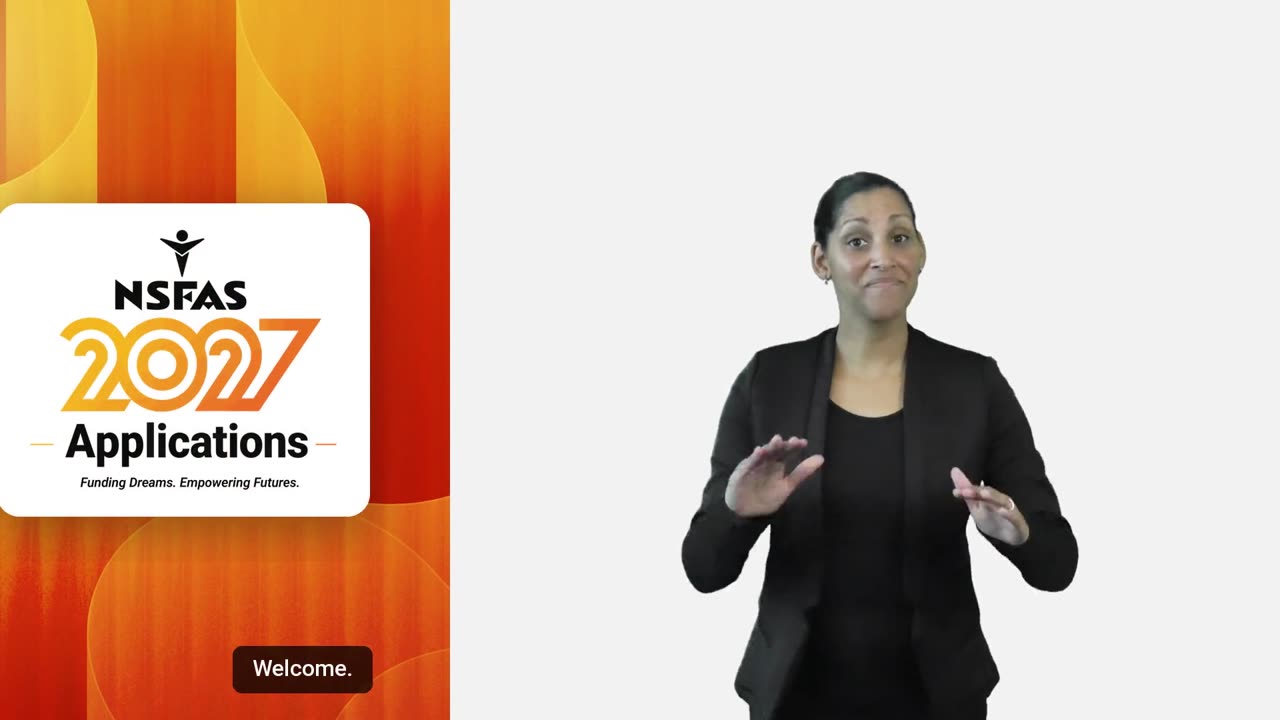
How to apply for 2027 funding, in South African Sign Language, with a spoken voice-over, captions on screen and a full written transcript.
SASL video
A SASL interpreter takes you through every step of applying for 2027 funding. Choose a part to jump to it.
Read the full transcript and choose a part to jump to
Choose any line or heading to jump to that part of the video. The line being signed is highlighted as the video plays.
Contact
Questions about your application, or about service providers for assistive devices? We’re here to help.